IoT companies in Spain: who builds the hardware, the platform and the app for your device
When a manufacturer contacts us because they need an app for their device, the first question is usually: “Which IoT development company can do it all for me?” Our answer is another question: which part are you missing? A connected product has three pieces (the device with its electronics and firmware, the cloud platform and the app) and hardly any company in Spain does all three well.
In this article we look at IoT companies in Spain, grouped by the piece each one builds, so you know who to call for your project. We also explain what an app developer needs to connect to your device and which regulations already apply to connected products.
One thing first: this article is written by ABAMobile, and we build the app piece. That is why this article maps the other pieces (electronics engineering firms and IoT platforms, which complement the app) rather than comparing app developers; for that, see our selection of the best app development companies in Spain. Data was checked on each company’s website (November 2026) and no company has paid to appear.
In short
- An IoT product has three pieces: the device (electronics and firmware), the cloud platform and the app. Before looking for a supplier, work out which one you are missing.
- Spain has hardware engineering firms such as Accent Systems, IoT platforms such as Biotz, Barbara and Nealis Tech, and app developers that specialise in connecting to hardware, such as ABAMobile.
- An app developer can connect to any device as long as it has the documentation for its communication protocols, messages and security.
- The app can also update the device’s firmware and configure it over Bluetooth, Wi-Fi or NFC.
- Since 1 August 2025, internet-connected radio equipment in the EU must meet cybersecurity requirements (Radio Equipment Directive), and the Cyber Resilience Act applies in full from December 2027.
The three pieces of an IoT product and who builds each one
An IoT (Internet of Things) product is a physical device that communicates with other systems: with a nearby phone over Bluetooth or NFC, or with a server over Wi-Fi, mobile networks or LoRa. Each piece calls for a different kind of company. If you are still weighing up what it can do for your business, we cover the benefits of IoT for companies.
| Piece | What it includes | Who usually builds it |
|---|---|---|
| Device | Electronic design, board, firmware, connectivity (Bluetooth, Wi-Fi, NFC, LoRa, NB-IoT), certification | Electronics and firmware engineering firms, or the manufacturer’s own R&D team |
| Platform | Data ingestion, device fleet management, dashboards, integration with other systems | IoT platform or cloud software companies |
| App | Device set-up and commissioning, control, data display, alerts, firmware updates | App development companies with hardware experience |
If you are a manufacturer with your own engineering team, you will usually be missing the app and sometimes the platform. If you are starting from an idea with no hardware, you will need an electronics engineering firm first.
IoT companies in Spain by type: summary table
These are the companies we cover, grouped by the piece they specialise in. Within each group they appear in alphabetical order.
| Company | Base | Type | Best for |
|---|---|---|---|
| Accent Systems | Barcelona | Electronics and firmware | Designing and manufacturing a Bluetooth device from scratch |
| Libelium | Zaragoza | Electronics and platform | Sensor projects using existing hardware |
| Barbara | Madrid and Bilbao | Platform | Industry and energy with many devices in the field |
| Biotz | Gipuzkoa | Platform and software | Industrial manufacturers that need to manage devices and data |
| Nealis Tech (formerly IoTsens) | Castellón | Platform and sensors | Water management and smart cities |
| ABAMobile | Asturias | Apps | The set-up, installation or control app for a device, and its maintenance |
Electronics and firmware engineering
Accent Systems (Castellar del Vallès, Barcelona, since 2007). Designs electronics and low-power firmware and manufactures in its own plant. It has its own products such as Bluetooth beacons, trackers and electronic shelf labels, and also offers cloud and app development. A good fit if you need the device itself.
Libelium (Zaragoza). Manufactures its own IoT sensors and nodes and a platform to use their data. A good fit if your project is about measuring the environment (air quality, water, agriculture) and you can start from its devices rather than design a new one.
IoT platforms
Barbara (Madrid and Bilbao). A platform for deploying and managing applications and AI models on distributed industrial equipment (edge). Clients include Iberdrola and EDP. It does not build mobile apps.
Biotz (Oñati and Donostia). An IoT platform for ingesting data, managing devices and building dashboards, plus bespoke software development. It shows a smart home project for a boiler components manufacturer, with native apps, and clients such as Michelin and Orkli.
Nealis Tech (Castellón; the IoTsens website now redirects to this brand). Platform and sensors for smart cities and water management. With FACSA it manages around 14,000 smart water meters on a single platform.
The app that connects to the device
ABAMobile (Asturias, since 2012). We only build software: native, cross-platform and PWA apps that connect to devices over Bluetooth, Wi-Fi or NFC, and their maintenance. We hold ISO 9001 and ISO 27001 (information security management) certifications, which fit the cybersecurity requirements EU rules now place on connected products. We do not design electronics: we work with the engineering firm our client chooses, or find partners. Projects on our website include Circutor’s app that connects its equipment over Bluetooth, Infitech’s Gecko apps for installing and monitoring energy systems, and the Shadow SOS app for V16 warning beacons for Grupo Corredoira.
If you want to compare several app developers, our selection of the best app development companies in Spain sets out each one\’s profile and what to look for when choosing.
What an app developer needs to connect to your device
An app development company can connect to practically any device, as long as it has the information on its communication protocols, messages and security. That is the only limit: everything else depends on having the documentation.
In practice, this is what we ask a manufacturer for at the start:
- Communication protocol: how the device talks (Bluetooth Low Energy, Wi-Fi, NFC, MQTT, CoAP…) and, for Bluetooth, which services and characteristics it exposes.
- Messages and commands: what the device can be asked to do, what it returns and in what format.
- Security: how it pairs, how data is encrypted and how keys are managed.
- Test units: devices or prototypes to test the app in real conditions.
- A contact in the firmware team: to answer questions and explain what changes in each version.
When part of that information is missing, the project does not stop, but it takes longer: the device’s behaviour has to be worked out through testing. That is why it pays to prepare the documentation before asking for a quote.
What the manufacturer does and what the app developer does
In an IoT project, the manufacturer owns the device and its firmware, and the app developer builds the experience for installers and users. Agreeing who does each task avoids most delays.
| Task | Manufacturer or its engineering firm | App developer |
|---|---|---|
| Define the protocol and messages | Yes | Reviews them and suggests improvements with the app in mind |
| Device firmware | Yes | No |
| Update firmware on installed devices | Prepares the file for each version | The app downloads it and installs it on the device |
| Initial set-up (Wi-Fi, parameters, device registration) | Defines what is configured | Designs the step-by-step process in the app |
| Cloud platform | Its own, or a platform provider’s | Integrates the app with it, or builds it if none exists |
| Publishing and maintenance on Google Play and the App Store | Owns the app listing | Publishes, updates and adapts the app to each Android and iOS version |
| Regulatory compliance of the product (RED, CRA) | Responsible | Applies the security requirements in the app |
What we have learnt connecting apps to devices
At ABAMobile we have connected apps to energy efficiency equipment, locks, warning beacons, energy meters and medical devices. These are the lessons we repeat most often to manufacturers:
- There are almost always two different users. The installer needs to commission the device quickly and without mistakes; the end user wants to check or operate it without thinking. For a smart lock system we maintain one app to configure the locks and another to open them; for Gecko, one app for the installer and another to monitor the installation.
- Commissioning is where the biggest gains are. Circutor’s apps, over Bluetooth and Wi-Fi, and Sistena’s app are used to connect devices and commission installations from a phone.
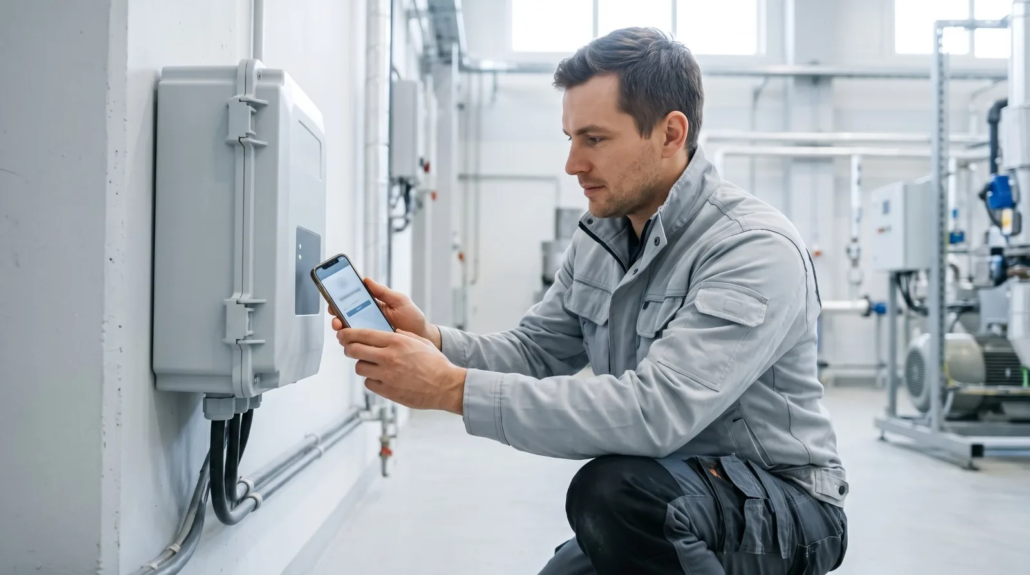
- The app can update the firmware. We have built firmware updates into apps so that installers and users need no tools or cables.
- NFC can configure devices, not just read tags. We have used it to configure equipment by tapping a phone against it, for example in projects for PVH and ProInsightsGo.
- The protocol is not always Bluetooth. In a home energy monitoring app we configure the meter and read its data over Wi-Fi using the CoAP protocol; in a medical app, over Bluetooth with a scale and a glucose meter.
If you manufacture equipment, our page on apps for manufacturing companies explains how we work, and our page on Bluetooth integration covers the technology.
How to choose a company for your IoT device app
When choosing an IoT app development company, the most useful thing is to ask about real devices it has connected and how it works with firmware. These are the questions we would ask:
| Question | Why it matters |
|---|---|
| Which devices have you connected, and with which protocols? | Bluetooth, Wi-Fi, NFC and MQTT each have their own problems; prior experience saves weeks. |
| How do you test the app without the final device? | Simulators and prototypes let the work progress while the hardware is being finished. |
| Can you update the firmware from the app? | It avoids site visits and special tools to keep devices up to date. |
| Do you work with my engineering team or with a hardware partner? | Coordinating the app and the firmware is the part that most often gets complicated. |
| Who maintains the app when the firmware or operating system changes? | Android and iOS change every year, and each firmware version may require changes to the app. |
| Are you familiar with the Radio Equipment Directive and the Cyber Resilience Act? | The app’s security is part of the product’s security. |
Regulations affecting IoT devices with an app
Two EU rules already require manufacturers of connected devices to take care of cybersecurity, and they also affect the app that controls them:
- Radio Equipment Directive (RED): since 1 August 2025, internet-connected radio equipment must meet cybersecurity requirements (Delegated Regulation (EU) 2022/30), with the EN 18031 standards as the reference.
- Cyber Resilience Act (CRA): Regulation (EU) 2024/2847 has required reporting of actively exploited vulnerabilities and severe incidents since 11 September 2026, and its remaining obligations apply from 11 December 2027, when it replaces the RED cybersecurity requirements.
We cover this in more detail in our article on IoT security and regulations.
Frequently asked questions about IoT app development companies
Which companies develop IoT apps in Spain?
It depends on the piece you need. For the device, engineering firms such as Accent Systems; for the platform, Biotz, Barbara or Nealis Tech; for the app that connects to the device, app developers with hardware experience such as ABAMobile. Few companies do all three pieces well, so combining two suppliers is common.
Can an app developer connect to any device?
Yes, as long as it has the device documentation: communication protocol, messages and commands, and security mechanisms. With that information there are no technical limits. Without it, the project takes longer because the device’s behaviour has to be worked out through testing.
Do I need the same company for the hardware and the app?
No. Manufacturers often have their own engineering team or work with an electronics firm, while a specialist app developer builds the app. What matters is that both coordinate from the start and that the protocol is documented.
Can a device’s firmware be updated from the app?
Yes. The manufacturer prepares the file for each firmware version and the app downloads it and installs it on the device over Bluetooth or Wi-Fi. Installers and users can update devices without tools or cables, and the manufacturer can fix bugs and vulnerabilities on devices already in the field.
Which regulations apply to an app that controls an IoT device?
In the European Union, the Radio Equipment Directive has required cybersecurity measures for connected radio equipment since August 2025, and the Cyber Resilience Act (CRA) applies in full from December 2027. The product manufacturer is responsible, but the app is part of the product’s security.
Before looking for a supplier, identify the piece you are missing
The useful question is not which company does IoT, but which part of your product you need: the device, the platform or the app. With that clear, and with the protocol documentation ready, any project moves much faster. If what you are missing is the app, tell us what your device does and we will tell you how we would connect to it.