Smart Building: Architecture, Regulations and ROI for Intelligent Buildings
A smart building is not defined by having isolated sensors, but by an architecture that connects every physical sensor to a central management system, the BMS. If you are wondering what infrastructure makes that connection possible and whether your existing building can access it, the short answer is: yes, through retrofitting, with a measurable return on investment of between 3 and 5 years.
Another key element of a smart building is software and, of course, the apps that can be used with this type of building. We will look at this later.
What is a smart building? Differences between building automation and home automation
The first thing to bear in mind is that the correct term for a corporate or industrial building is not home automation, but building automation. Home automation automates isolated functions in residential properties; building automation centrally manages HVAC, access control, energy and security through a BMS (Building Management System) or BAS.
In a home, we would typically manage smart light bulbs and household devices, whereas in a large corporate building, we manage a data ecosystem that decides, for example, when to pre-condition a floor based on actual occupancy patterns.
Technology architecture and protocols in a smart building
The foundation of every smart building is a layer of IoT sensors that measures temperature, CO2, electricity consumption and occupancy. This information is sent to the BMS, which centralizes and automates decisions without constant manual intervention. All of this can be summarized in four main areas:
1. IoT sensors and edge computing
Processing data close to where it is generated, within the building itself, reduces latency compared with relying exclusively on the cloud. This edge computing approach also limits the exposure of sensitive data outside the local network, something that in our work with IoT applications we prioritize from the architecture design stage.
2. Integration protocols: BACnet, KNX, LoRaWAN and MQTT
Interoperability between manufacturers is achieved through open standards. BACnet and KNX dominate HVAC and lighting control; LoRaWAN connects low-power wireless sensors over long distances, while MQTT transports this data to cloud or edge platforms. However, it is worth noting that, in our experience, not all manufacturers use open standards, and this is an important factor to consider because it can make the entire process more complex.
3. BIM 6D/7D and digital twins
BIM methodology is not a 3D drawing; it is a collaborative database. Its 6D dimension provides energy analysis, while 7D manages maintenance throughout the asset’s entire lifecycle, subsequently feeding the Digital Twin, which simulates real-world scenarios.
4. Connected mobile applications
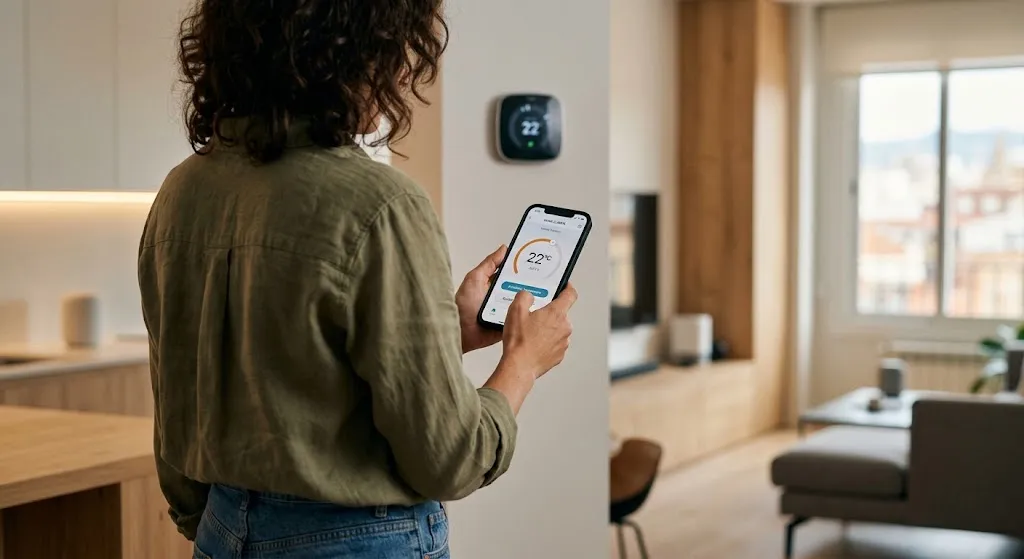
Beyond sensors and communication protocols, the true intelligence of a Smart Building is brought to life through the software layer and, of course, mobile applications. These apps act as the bridge between the building’s complex technical architecture (the BMS) and people. A mobile app connected through secure IoT architectures makes it possible to monitor consumption in real time, adjust HVAC systems or manage access directly from your pocket, transforming thousands of raw data points into fast, actionable decisions.
We explain more in this video:
Smart Building ROI in real estate
In practice, however, ROI always matters. For a property developer or the CEO of a construction company, the question is not technological but financial. According to CBRE data, smart buildings increase their value by 20% and can achieve rents up to 30% higher.
Asset appreciation and energy efficiency
JLL estimates the payback period for technology investment at between 3 and 5 years, thanks to energy and maintenance savings. This makes a smart building a more attractive PropTech asset for investors, something that is particularly relevant in projects in the construction and engineering sector.
| Indicator | Measured impact | Source |
|---|---|---|
| Asset value | +20% | CBRE |
| Achieved rents | +30% | CBRE |
| Return on investment | 3-5 years | JLL |
| Global market by 2030 | USD 400 billion (22.2% CAGR) | Fortune Business Insights |
European regulations and cybersecurity in smart buildings
Another important point is that the European Commission, through the EPBD Directive, requires the progressive decarbonization of the non-residential building stock.
1. EPBD Directive and the Smart Readiness Indicator (SRI)
The SRI measures a building’s ability to adapt its operation to the needs of occupants and the electricity grid. A high SRI directly supports the ESG criteria currently required by investors and institutional funds.
2. IT/OT cybersecurity: IEC 62443 and NIST CSF
The convergence of corporate networks (IT) and industrial control networks (OT) requires strict segmentation. The IEC 62443 and NIST CSF frameworks are key references for protecting access systems, elevators and HVAC systems against intrusions, a criterion that we also apply when developing applications for connected equipment manufacturers.
Types of connected mobile applications in a Smart Building
As mentioned earlier, software and apps are a fundamental part of the ecosystem. For the infrastructure of a smart building to be truly functional, the software layer must respond to the needs of each type of user who interacts with the property. Within the IoT ecosystem of a Smart Building, we mainly distinguish between three types of connected mobile applications:
-
Management and Facility Management apps (Mobile BMS):
Designed for administrators, technicians and asset managers. They enable real-time monitoring of energy consumption, centralized control of HVAC and lighting, the reception of critical incident alerts and predictive maintenance management from anywhere, without depending on a fixed control center.
-
End-user and tenant apps (Workplace & Tenant Apps):
Designed for employees, residents or visitors to the building. They transform the user experience by integrating features such as mobile access control (NFC applications, QR apps or Bluetooth apps), meeting-room and parking-space booking, personalized environmental comfort settings at the workplace and direct fault reporting.
-
Field and maintenance apps for IoT equipment manufacturers (Field Service Apps):
Specialized tools for installers and maintenance technicians working with machinery or connected sensors (HVAC, lighting, meters). They facilitate on-site commissioning, device diagnostics through local connections (Bluetooth Low Energy or NFC) and synchronization with industrial protocols before sending the data to the central platform.
From data to a self-managing building
Technology can now solve what once seemed complex: connecting sensors, protocols and regulations within a single intelligent decision-making layer. What many projects are still missing is a software architecture designed for this integration from day one.
If you are assessing how to make this transition in your building or facility, it is worth reviewing how IoT applications that connect to physical devices are designed before committing your budget.
Frequently Asked Questions – FAQs
1
The mobile app never connects directly to the building’s industrial control network (OT). Instead, it interacts through secure intermediary layers (APIs and Edge or Cloud platforms). To protect the convergence between the app and physical sensors or controllers, international standards such as IEC 62443 are applied, together with end-to-end data encryption, multi-factor authentication (MFA) and strict user role-based permission management, preventing any unauthorized access to critical systems.
What role do mobile applications play in a Smart Building if the building already has a BMS?
The BMS (Building Management System) operates in the background, processing data and carrying out the building’s industrial automation processes, but the mobile app is the interface that makes this intelligence actionable for people. While the central system manages the overall infrastructure, the mobile application allows Facility Managers to monitor alerts or consumption in real time from anywhere, while users and tenants can interact with their environment (smartphone access, space booking or environmental comfort adjustments).
What is the technical difference between residential home automation and an industrial building automation BMS?
The BMS simultaneously manages thousands of data points relating to HVAC, access control and energy at an industrial scale, whereas home automation controls isolated functions within a home without predictive analytics capabilities or multi-system integration.
How can an old building be transformed into smart infrastructure through retrofitting?
Wireless IoT sensors and controllers compatible with LoRaWAN or KNX are installed on top of the existing infrastructure, without the need for structural construction work. A prior BIM model maps the existing building in order to plan the integration and avoid unexpected issues.
How do the EPBD Directive and ESG criteria affect the valuation of real-estate assets?
The EPBD requires energy performance reporting; a low SRI can negatively affect the sale or rental value of the asset. ESG funds prioritize certified buildings, which can directly translate into better financing conditions.
Which cybersecurity protocols are critical for protecting IT/OT convergence in a Smart Building?
Network segmentation based on IEC 62443, end-to-end encryption and continuous monitoring in accordance with the NIST CSF are the three minimum pillars that should be in place before connecting any OT system to the corporate network.